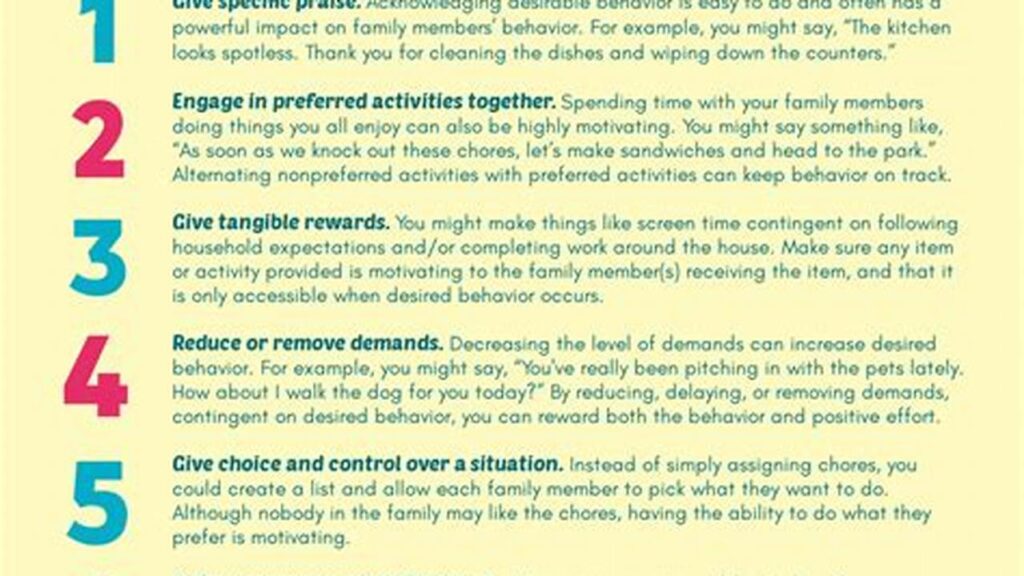

Raising children presents numerous challenges, and addressing behavioral issues effectively is crucial for fostering a positive family environment and supporting healthy child development. A structured approach to behavior management, emphasizing positive reinforcement and proactive strategies, can significantly improve parent-child interactions and promote desired behaviors.
Building Strong Parent-Child Relationships
Nurturing a secure and loving bond provides a foundation for effective discipline. Children who feel understood and supported are more receptive to guidance.
Setting Clear Expectations and Rules
Children thrive in structured environments. Clearly defined rules and expectations help them understand boundaries and develop self-regulation.
Focusing on Positive Reinforcement
Acknowledging and rewarding desired behaviors is more effective than solely punishing misbehavior. Positive reinforcement motivates children to repeat positive actions.
Providing Consistent Consequences
Consistency is key to effective discipline. Children learn to associate their actions with predictable outcomes when consequences are consistently applied.
Teaching Problem-Solving Skills
Equipping children with problem-solving strategies empowers them to navigate challenging situations independently and make responsible choices.
Creating a Supportive Environment
A structured and predictable environment reduces stress and promotes positive behavior. Consistent routines and organized spaces contribute to a sense of stability.
Seeking Professional Support When Needed
Don’t hesitate to seek guidance from child development experts or therapists when facing persistent behavioral challenges. Professional support can provide tailored strategies and resources.
Modeling Desired Behaviors
Children learn by observing the adults in their lives. Modeling positive behaviors, such as respectful communication and emotional regulation, teaches valuable life skills.
Tips for Implementing Positive Behavior Strategies:
Tip 1: Use specific praise to acknowledge desired behaviors. Instead of saying “good job,” try “I appreciate how you helped your sister clean up.”
Tip 2: Create a visual chart to track progress and reward positive behavior. This provides a tangible representation of achievements.
Tip 3: Involve children in setting rules and consequences. This fosters a sense of ownership and responsibility.
Tip 4: Remain calm and patient during challenging moments. Modeling emotional regulation teaches children valuable coping skills.
Frequently Asked Questions:
Q: How do I handle tantrums effectively?
Remain calm and avoid giving in to demands. Provide a safe space for the child to calm down and offer comfort once the tantrum has subsided.
Q: What if positive reinforcement doesn’t seem to be working?
Evaluate the reinforcement system and ensure it is tailored to the child’s interests and developmental stage. Consistency is crucial for effectiveness.
Q: How can I address sibling rivalry?
Encourage cooperation and positive interactions by implementing shared activities and individual special time with each child.
Q: When should I seek professional help for my child’s behavior?
If behaviors are significantly impacting family life, school performance, or the child’s well-being, seeking professional guidance is recommended.
Q: How can I maintain consistency with these strategies when I’m feeling overwhelmed?
Prioritize self-care and seek support from family, friends, or a therapist. Managing parental stress is crucial for consistent parenting.
Q: Are these strategies effective for children of all ages?
These core principles can be adapted to suit different developmental stages. Specific techniques may vary depending on the child’s age and individual needs.
Implementing these strategies requires patience and consistency, but the long-term benefits are significant. By focusing on positive reinforcement, clear communication, and a supportive environment, parents can nurture well-adjusted children and foster strong family relationships.