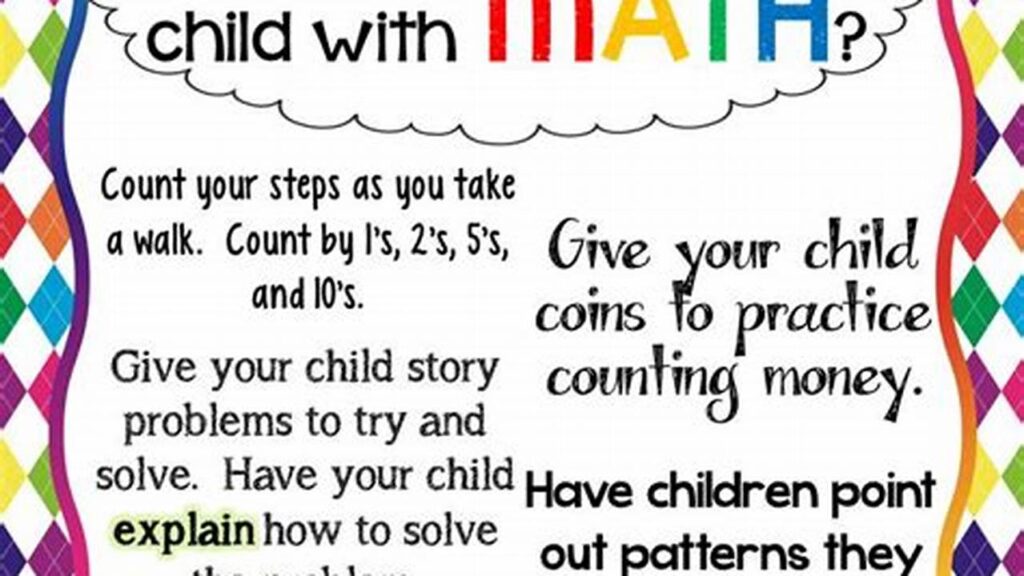

Integrating mathematical concepts into everyday life can significantly enhance a child’s understanding and appreciation for the subject. Practical application of math principles at home provides a supportive learning environment where children can explore, experiment, and build confidence in their abilities. This approach fosters a positive attitude towards math, reducing anxiety and encouraging a lifelong love of learning.
Counting and Number Recognition
Engage children in counting everyday objects like toys, fruits, or stairs. This helps them grasp basic number concepts and develop number sense.
Shape Recognition and Spatial Reasoning
Playing with building blocks, puzzles, or drawing shapes helps children visualize and understand spatial relationships and geometric concepts.
Measurement and Comparison
Baking or cooking together provides opportunities to measure ingredients, introducing concepts like volume, weight, and fractions.
Pattern Recognition and Sequencing
Identifying patterns in everyday objects, music, or nature cultivates logical thinking and problem-solving skills.
Time and Calendar Skills
Using a calendar or timer to schedule activities helps children understand time management and sequencing of events.
Money Management and Basic Arithmetic
Giving children a small allowance and letting them make purchasing decisions introduces basic financial literacy and arithmetic operations.
Data Analysis and Graphing
Creating simple charts or graphs to track weather, plant growth, or favorite colors introduces data collection and representation.
Problem-Solving through Games
Board games, card games, and logic puzzles provide engaging opportunities to develop critical thinking and problem-solving skills.
Real-World Application
Connecting math concepts to real-life scenarios, such as calculating distances during travel or budgeting for groceries, makes learning more meaningful and relevant.
Tips for Effective Home Math Learning
Tip 1: Keep it playful and engaging. Learning should be fun and not feel like a chore.
Tip 2: Use concrete materials. Manipulatives like blocks, beads, or counters help children visualize abstract concepts.
Tip 3: Relate math to their interests. Incorporate their favorite toys, hobbies, or characters into math activities.
Tip 4: Be patient and encouraging. Focus on progress, not perfection, and celebrate their efforts.
Frequently Asked Questions
How can I make math fun for my child?
Incorporate games, puzzles, and hands-on activities to make learning enjoyable and engaging.
What if my child struggles with a particular concept?
Break down the concept into smaller steps, use visual aids, and offer plenty of practice and encouragement. Don’t hesitate to seek additional resources or support if needed.
How much time should I dedicate to math practice at home?
Short, regular practice sessions are more effective than long, infrequent ones. Even 15-20 minutes a day can make a significant difference.
How can I assess my child’s progress?
Observe their problem-solving skills, ask open-ended questions, and review their work. Formal assessments are not always necessary, but can be helpful in identifying areas for improvement.
What are some examples of real-world math applications?
Calculating grocery costs, measuring ingredients for cooking, determining travel distances, and managing a budget are all real-world examples of math in action.
How can I support my child’s math learning if I’m not confident in my own math skills?
There are numerous online resources, books, and educational apps available to help parents refresh their math knowledge and support their children’s learning. Don’t be afraid to learn alongside your child!
Cultivating a positive and engaging learning environment at home can significantly impact a child’s mathematical development. By incorporating these strategies and tips, parents can empower their children to embrace math with confidence and enthusiasm, setting them up for future success.